
AI in energy management: why it's the future (and what it looks like in practice)
AI energy management enables predictive charging/discharging scheduling and battery optimization—beyond manual settings. Learn what it looks like in practice.
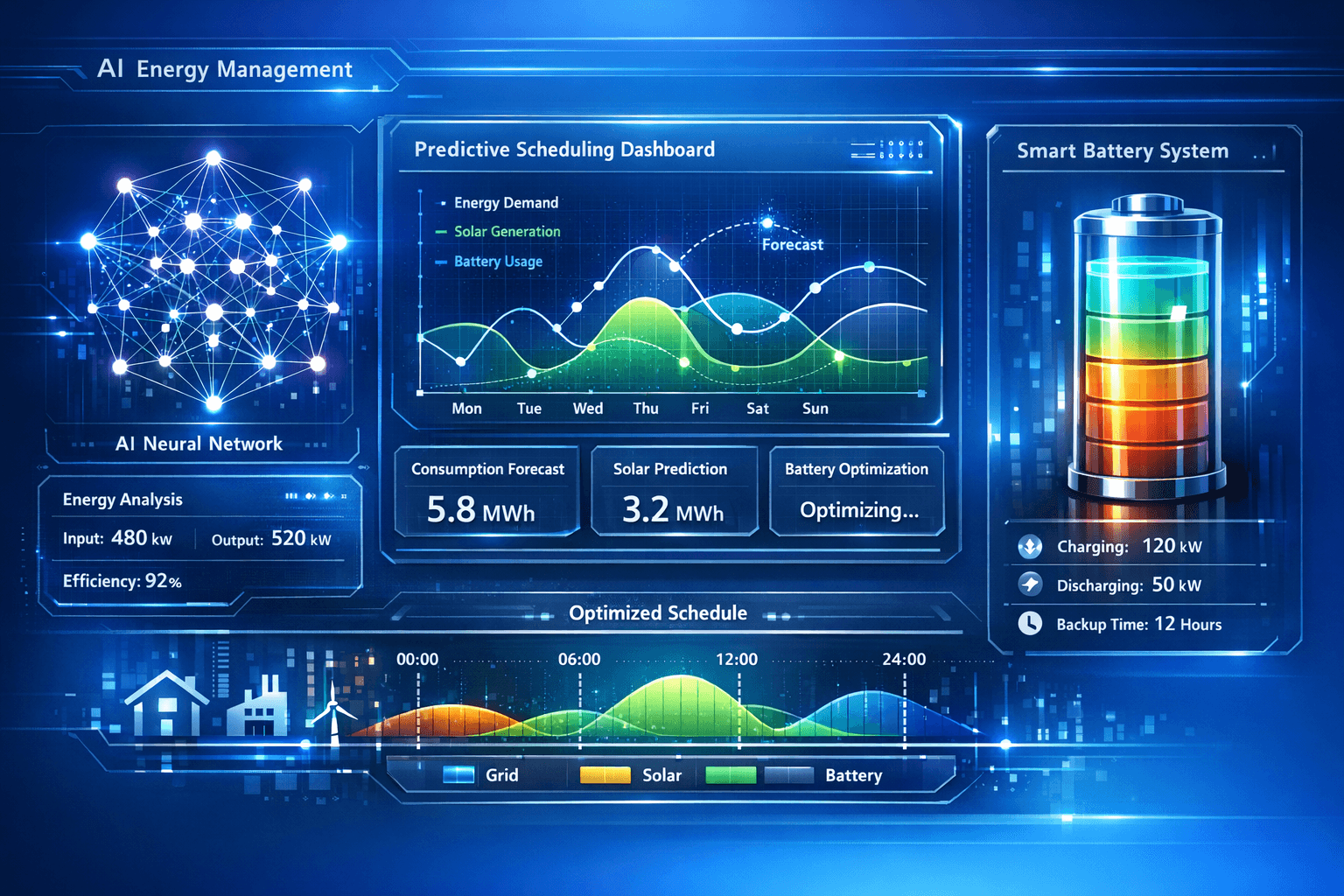
AI energy management: why it's the future (and what it looks like in practice)
AI energy management is the shift from fixed, manual charging/discharging rules to predictive scheduling and battery optimization that adapts every day (and often every hour) to prices, load, weather, and operational constraints. This article is for CTOs, energy managers, and innovation officers who need measurable savings and reliability—without turning their team into an “energy trading desk”. You’ll learn what AI actually changes in day-to-day battery operation, where manual settings fail, and what “good” AI automation looks like in practice.
Many companies already have an ESS/BESS installed—or are about to invest—and discover the hard part isn’t the hardware. The hard part is deciding when to charge and when to discharge, under uncertainty, while protecting battery lifetime and keeping operations safe. That is exactly where AI-driven energy automation becomes a practical advantage.
What’s really changing: from “rules” to “decisions”
Manual settings usually mean one of these approaches:
- Calendar schedules (e.g., charge at night, discharge at 8–10 and 16–19)
- Static thresholds (e.g., discharge above X kW load, charge below Y price)
- Operator-driven actions (someone “keeps an eye on it”)
They can work in stable environments—but modern energy systems are not stable:
- renewable production is volatile,
- consumption patterns drift,
- dynamic tariffs and day-ahead markets change daily,
- constraints (contracted power, peak charges, export limits) can shift.
AI in energy management replaces “set-and-forget rules” with continuous decision-making based on forecasts and feedback loops—an approach widely discussed as a key use case for AI in energy and grid management (Ringover).
What is AI energy management?
AI energy management is the use of machine learning and optimization to predict what will happen (load, PV output, prices, constraints) and then schedule control actions (charge/discharge, setpoints, limits) to meet business goals.
In practice, it’s not “one big AI brain.” It’s typically a combination of:
- Forecasting models (predict load, PV, prices, peaks)
- Optimization engine (choose best charge/discharge plan under constraints)
- Real-time control (execute the plan, adjust when reality deviates)
- Health & safety layer (temperature, SoC, cycle limits, alarms)
This is why the conversation about AI in energy is increasingly linked to operational efficiency and system-wide optimization—not just analytics dashboards (World Economic Forum).
How does AI-driven charging/discharging scheduling work?
Think of AI scheduling as a loop that runs continuously:
-
Collect data
- meter data (15-min, 5-min, or even 1-min)
- ESS telemetry (SoC, power, temperature, alarms)
- PV/wind data (production, forecasts)
- price signals (fixed tariff, TOU, dynamic, day-ahead)
- operational constraints (contracted power, export limits, critical loads)
-
Forecast
- “What will my demand look like today?”
- “When will my PV overproduce?”
- “When are the expensive hours likely to hit?”
-
Optimize
- choose charging/discharging plan that minimizes cost and risk
- keep within constraints (battery limits, grid limits, contractual limits)
-
Execute and correct
- follow the plan, but adapt if:
- a production line starts unexpectedly,
- weather changes,
- prices spike,
- the battery temperature rises,
- a grid event occurs.
- follow the plan, but adapt if:
This kind of dynamic adjustment is exactly what separates AI from manual scheduling, which is inherently reactive and limited by human attention (Ringover).
Manual settings vs AI scheduling (what’s the real difference?)
| Area | Manual scheduling (rules/calendar) | AI scheduling (predictive + adaptive) |
|---|---|---|
| Handling volatile prices | Often ignores intraday variability or day-ahead changes | Incorporates price forecasts and can re-plan daily/hourly |
| PV/renewables volatility | Fixed assumptions (“sunny day pattern”) | Uses weather and production forecasts, updates with real measurements |
| Peak demand | Threshold-based, can miss true peaks or create new ones | Predicts peaks and plans discharge to reduce maximum demand |
| Battery lifetime | Often “overcycles” due to simplistic logic | Balances savings vs cycle cost; can be configured for longevity targets |
| Staffing & reliability | Requires attention; “works until it doesn’t” | Designed for 24/7 automation with exception-based oversight |
| Learning over time | No learning | Models improve as more site-specific data is collected |
Applications of AI energy management in ESS/BESS
AI is not one use case—it’s an operating layer that can serve multiple business outcomes.
1) Cost optimization and energy arbitrage (when it makes sense)
If your tariff or market exposure creates meaningful hourly price differences, AI can:
- charge when energy is cheaper,
- discharge when energy is more expensive,
- avoid charging during high-price windows even if the calendar says otherwise.
This is particularly relevant as energy markets modernize and volatility increases—an often-cited driver for AI adoption in the sector (Carbon Direct).
2) Peak shaving and contracted power protection
For many businesses, the fastest and most reliable value comes from reducing peaks:
- avoid penalty fees,
- reduce contracted power needs,
- protect sensitive processes from sudden spikes.
AI helps because the “peak” is rarely at the same time every day. It’s usually caused by a combination of:
- shift changes,
- compressors cycling,
- HVAC,
- charging infrastructure,
- production variability.
A predictive model can anticipate the peak before it happens and discharge proactively—rather than triggering when it’s already too late.
3) Renewable self-consumption and export limiting
When PV production exceeds on-site demand, the ESS can store the surplus. Manual logic often fails on:
- partly cloudy days,
- seasonal patterns,
- curtailment/export limits.
AI can align storage with weather-driven PV variability, improving self-consumption and reducing waste—commonly highlighted as a core AI benefit for renewable integration (Ringover).
4) Resilience and operational continuity (without overbuilding)
Even if you don’t operate as a full UPS, an ESS can support:
- ride-through for short grid issues,
- smoother operations during voltage/frequency events (when allowed by interconnection rules),
- prioritized supply to critical loads (depending on topology).
AI adds value by ensuring the battery is at the right state-of-charge at the right time—rather than “accidentally empty” when you need it.
5) Predictive maintenance and condition-based operation
One practical benefit: AI can flag early indicators of abnormal behavior (temperature trends, efficiency drops, unusual SoC dynamics) and shift from rigid maintenance intervals to condition-based actions—a pattern described broadly in AI-for-energy discussions (Ringover).
Benefits of AI energy management (beyond “it’s smarter”)
Better economics: fewer missed opportunities
Manual schedules miss savings because they don’t see the full picture:
- weather changes,
- production anomalies,
- price spikes,
- a changed shift plan.
AI is designed to reduce these “missed windows” by re-planning continuously.
Less operational risk: fewer human errors
If your ESS requires daily manual intervention, errors are inevitable:
- forgotten schedule updates,
- wrong setpoints,
- conflicting rules,
- “temporary” changes that become permanent.
AI-based automation reduces risk by moving decision-making into a controlled system with logging, constraints, and repeatable logic—an approach aligned with the broader enterprise trend of using AI for efficiency and productivity gains (Deloitte).
Longer battery life (when configured correctly)
Battery lifetime is influenced by temperature, depth of discharge, C-rate, and overall cycling strategy. AI scheduling can be tuned to:
- cap cycling intensity,
- avoid unnecessary micro-cycles,
- keep operation in “battery-friendly” windows,
- prioritize savings only when they exceed the “degradation cost”.
Better sustainability outcomes
Sector-wide analyses often argue that AI-driven efficiency can materially reduce emissions by cutting waste and enabling better renewable integration—especially as electrification grows (CarbonCredits.com).
What AI energy management looks like in practice (a realistic daily scenario)
Here’s a simplified example for a mid-sized industrial site with PV and a BESS:
Morning (06:00–10:00): avoid the first peak
- Forecast sees a production ramp at 07:30 and HVAC load increase.
- AI schedules partial discharge before the peak to flatten demand.
- Result: peak shaved without emptying the battery too early.
Midday (10:00–15:00): capture PV surplus, respect constraints
- Weather forecast predicts intermittent clouds.
- Instead of charging at max power continuously, AI uses a smoother plan:
- charge aggressively during clear periods,
- reduce charging when PV dips to avoid importing from the grid unintentionally.
Late afternoon (15:00–20:00): expensive energy window
- Price signal indicates higher-cost hours.
- AI keeps enough SoC to discharge through the expensive period, but:
- avoids deep discharge if tomorrow’s morning peak is forecasted higher.
Night (20:00–06:00): restore readiness and optimize for tomorrow
- AI charges only as much as needed:
- to be ready for morning peaks,
- to capture expected PV surplus,
- to meet resilience/backup targets.
This “plan + adapt” flow is the practical meaning of predictive scheduling—something manual settings struggle to execute without constant attention (Ringover).
A quick decision checklist: is AI scheduling worth it for your site?
AI adds the most value when at least two of these are true:
- You have variable load (production changes, multiple shifts, cycling equipment)
- You have PV or other renewables with intermittent output
- Your tariff includes peak demand charges or contracted power penalties
- You have dynamic pricing (or frequent tariff changes)
- You need hands-off operation (small team, limited energy expertise)
- You want consistent outcomes across seasons, not just “best effort”
What data do you need to calculate ROI?
To accurately calculate energy storage savings, you need:
- Energy consumption profile (hourly or 15-minute intervals) or invoices + interval data
- Tariff / pricing model (fixed vs dynamic)
- Contracted power / peak demand information
- Existing PV installation details (kWp, production, self-consumption)
Who is AI energy management for?
CTOs
You’re responsible for systems that must work reliably with minimal operational overhead. AI energy automation is attractive when you want:
- fewer manual processes,
- predictable governance (logs, permissions, alerts),
- integration with existing infrastructure.
Energy managers
You need measurable savings, month after month. AI helps when:
- peaks are hard to predict,
- tariffs change,
- PV output is volatile,
- you need to report results clearly.
Innovation officers
You’re looking for scalable, future-proof initiatives. AI energy management aligns with the broader trend that digital intelligence will shape the next phase of the energy transition (World Economic Forum).
What to ask vendors (so “AI” isn’t just marketing)
Use these questions to separate real automation from “smart rules”:
- What forecasts are used? Load, PV, weather, prices? How often are they updated?
- How is battery degradation handled? Is cycling cost considered?
- What constraints are enforced? Contracted power, export limits, SoC reserve, temperature limits?
- Is it explainable? Can you see why the system charged/discharged at a specific time?
- How does it fail safely? What happens if sensors fail, forecasts are wrong, or connectivity drops?
- What is the operating model? Do we need daily tuning, or is it truly 100% automatic?
Why AIESS?
AIESS energy storage systems stand out with:
- AI Control - automatic charge/discharge scheduling
- Forecasts - energy prices, weather, load predictions
- 24/7 Monitoring - savings reports and continuous optimization
If you want a high-level view of our approach to energy storage for businesses, see our main site: aiess.pl.
FAQ (Frequently Asked Questions)
-
Is AI energy management only for companies on dynamic electricity prices?
No. Dynamic pricing increases the upside, but AI is often valuable even on standard tariffs because it improves peak shaving, PV self-consumption, and operational readiness. -
Can AI scheduling work with an existing ESS/BESS?
Often yes—if the system supports the required control interfaces and telemetry. The key is integration: metering, tariff logic, PV signals, and safe control limits. -
Does AI replace human control completely?
In well-designed systems, daily operation can be 100% automatic, but humans still define goals and constraints (e.g., minimum SoC reserve, peak targets) and oversee exceptions. -
Will AI increase battery wear because it cycles more?
It can if poorly configured. Proper battery optimization balances savings against degradation and avoids unnecessary cycling. -
What’s the biggest mistake in manual charge/discharge settings?
Assuming the same schedule works every day. Real operations vary, and manual schedules typically fail on “edge days” that create most costs (unexpected peaks, price spikes, weather shifts). -
How quickly can we see results after enabling AI scheduling?
Many sites see measurable changes within weeks because peak reduction and better PV capture show up immediately. Full optimization improves as the model learns site-specific patterns. -
Is AI energy management relevant for grids and regulation trends?
Yes. As electrification and digital infrastructure expand, AI is increasingly viewed as necessary for managing complexity and system stress (Carbon Direct; CarbonCredits.com).
Summary
AI energy management is the practical evolution from manual, rule-based battery operation to predictive scheduling that adapts to real-world variability—prices, load, weather, and constraints. For CTOs and energy managers, the key benefit is not “more data,” but better decisions made automatically: lower peaks, better renewable integration, fewer operational mistakes, and a clearer path to consistent savings.
Next steps
If you’re considering ESS/BESS automation (or you already have storage and want better results):
- Estimate savings and payback: Calculate ROI in 2 minutes →
- See how AIESS automates energy management: aiess.pl
- Discuss an implementation path: View our offer →
Related articles
- What is an energy storage system (ESS) and how does it work?
- Peak shaving with a BESS: how businesses reduce demand charges
- How to choose a commercial battery storage system (BESS)
- PV + battery: increasing self-consumption in commercial sites
Sources and References
Article based on data and insights from:
- Ringover (2026). “AI in the Energy Sector 2026: Key Use Cases and Benefits.”
https://www.ringover.com/blog/ai-for-energy - Optera (2026). “2026 Predictions: How AI will impact energy use and climate work.”
https://opteraclimate.com/2026-predictions-how-ai-will-impact-energy-use-and-climate-work/ - CarbonCredits.com (2026). “Why BlackRock Flags AI as a New Stress Test for Clean Energy in 2026.”
https://carboncredits.com/why-blackrock-flags-ai-as-a-new-stress-test-for-clean-energy-in-2026/ - Carbon Direct (2026). “AI scale and climate commitments: A 2026 outlook.”
https://www.carbon-direct.com/insights/ai-scale-and-climate-commitments-a-2026-outlook - World Economic Forum (2026). “Encouraging energy transition innovation and investment.”
https://www.weforum.org/stories/2026/01/innovation-digital-energy-transition/ - Deloitte (2026). “The State of AI in the Enterprise - 2026 AI report.”
https://www.deloitte.com/us/en/what-we-do/capabilities/applied-artificial-intelligence/content/state-of-ai-in-the-enterprise.html
Last updated: January 31, 2026